
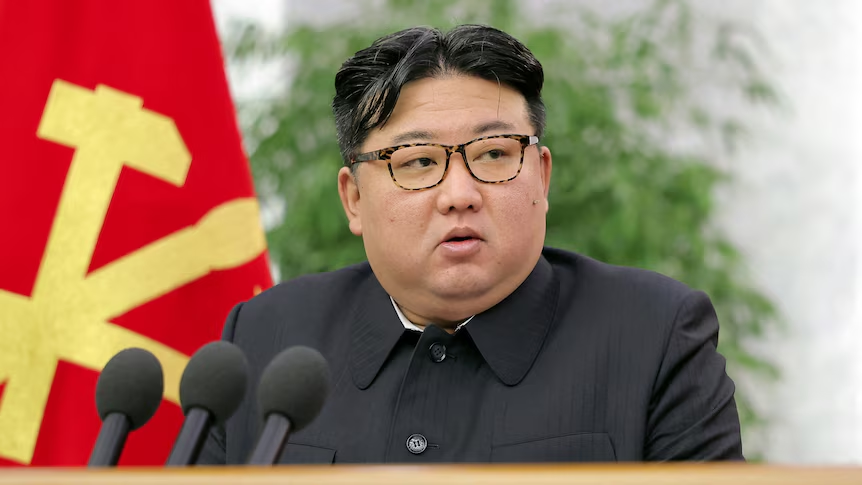
North Korea has conducted a test launch of long-range strategic cruise missiles, with leader Kim Jong Un personally overseeing the operation as part of a broader effort to advance the country’s military capabilities.
The exercise, which took place late Sunday, was described by Pyongyang as a demonstration of its strategic readiness and deterrence capability amid ongoing regional security concerns.
Missile Tests Highlight Strategic Military Priorities
The missiles were launched over the sea to the west of the Korean Peninsula and successfully hit designated targets during the drill. North Korean state commentary emphasized that the exercise was intended to verify the reliability, maneuverability and combat readiness of these strategic weapon systems — a vital part of the nation’s defense posture as it faces what its leadership describes as persistent external threats.
Kim Jong Un conveyed “great satisfaction” with the flight paths and performance of the cruise missiles, framing the launch as a responsible demonstration of the country’s nuclear combat readiness. He reiterated Pyongyang’s commitment to the “unlimited and sustained development” of its military capabilities, including its nuclear deterrent forces.
What Are Long-Range Cruise Missiles?
Long-range cruise missiles are designed to travel significant distances with high precision, often flying at low altitudes to evade radar detection. These missiles can be equipped with either conventional or nuclear payloads, depending on strategic intent and delivery systems. Their accuracy and stealth characteristics make them a core element of modern military deterrence strategies.
In North Korea’s case, these tests are part of a broader push to enhance precision strike capability and bolster strategic options for counterattack and defense. Flexible deployment methods — including possible submarine launches — have been highlighted in past demonstrations and development programs.
Timing and Political Context
The test occurs just weeks ahead of North Korea’s Ninth Congress of the Workers’ Party, a key political event expected in early 2026 during which leadership will outline national priorities and long-term development plans. Kim has used recent months to showcase military advances alongside economic and infrastructure achievements, aiming to project strength internally and externally. Experts suggest that these missile drills not only serve technical evaluation purposes but also act as political signaling — reinforcing Pyongyang’s posture in the face of perceived external pressures and shifting geopolitical alliances.
Regional Security Impact
Neighboring countries, particularly South Korea and Japan, monitor North Korea’s weapons tests closely. South Korea’s defense establishment detected the missile launches and reaffirmed its readiness to respond to any threats, underscoring the persistent volatility on the Korean Peninsula. Although tests of cruise missiles are not banned under current U.N. Security Council resolutions — which primarily restrict ballistic missile and nuclear weapons activity — such launches still raise security concerns because of their potential to carry nuclear or conventional warheads and their capacity to challenge regional defenses.
International Reactions and Strategic Concerns
International responses to North Korea’s missile activities often emphasize concern over rising military tensions and the potential for escalation. Allied nations in the region, including the United States and South Korea, maintain robust surveillance and defense cooperation to deter possible provocations.
Analysts note that North Korea’s advancements in missile technology — alongside other weapons programs — could test diplomatic patience and complicate ongoing efforts aimed at promoting stability or resuming dialogue. At the same time, Pyongyang’s rhetoric frames these developments as essential for national defense amid what it characterizes as hostile foreign policies and military alliances.
What Comes Next
Military analysts expect that North Korea may continue weapons tests around major national events or holidays, using them to reinforce internal cohesion and external messaging. Future drills could include further cruise missile launches, high-altitude surface-to-air missile tests, or demonstrations involving emerging delivery platforms such as possible submarine-launched systems.
The international community will likely keep a close eye on these developments as part of broader assessments of security dynamics in East Asia and the strategic calculus surrounding North Korea’s evolving arsenal.