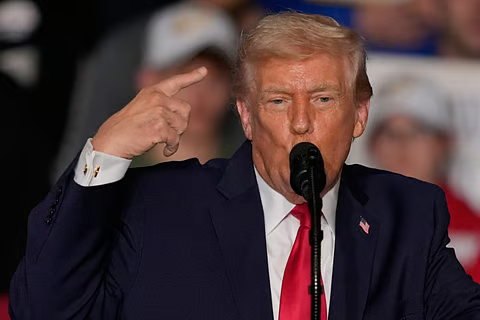

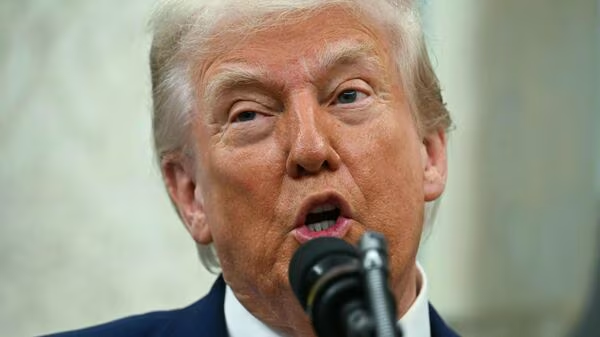
Former U.S. President Donald Trump has issued a blunt warning to the United Kingdom, saying it is “very dangerous” for Britain to deepen economic or strategic ties with China.
The comments reflect Trump’s long-standing hardline stance on China and underline growing tensions among Western allies over how to engage with Beijing amid rising geopolitical competition.
Trump’s Warning to Britain
Trump argued that closer UK-China cooperation could expose Britain to:
-
Security risks
-
Economic dependency
-
Political influence from Beijing
He suggested that China uses trade, investment, and technology partnerships as leverage, warning that Western nations often underestimate the long-term consequences of such engagement.
According to Trump, the UK should align more closely with the United States and other allies rather than expanding ties with China.
Why China Is a Flashpoint
China has become a central issue in global geopolitics due to concerns over:
-
National security and espionage
-
Technology transfer and data access
-
Supply-chain dependence
-
Strategic influence through infrastructure and investment
Trump has repeatedly claimed that Beijing uses economic relationships to gain political and strategic advantage — a view shared by some policymakers but disputed by others.
UK’s Balancing Act

Britain faces a complex challenge. China is:
-
A major trading partner
-
A key market for British exports
-
An important player in global supply chains
At the same time, the UK remains a close security ally of the U.S. through intelligence-sharing and defense cooperation. Trump’s warning highlights the growing difficulty of balancing economic opportunity with strategic caution.
A Familiar Trump Message
Trump’s remarks are consistent with his broader worldview:
-
Skepticism of globalization
-
Preference for allied economic blocs
-
Confrontation over cooperation with China
During his presidency, he frequently urged allies to reduce reliance on Chinese technology and investment, arguing that Western unity was essential to counter Beijing’s rise.
Reactions and Implications
Supporters of Trump’s position argue that:
-
Economic engagement with China carries hidden costs
-
Security risks often emerge years later
-
Allies should act collectively
Critics counter that:
-
Cutting ties with China is unrealistic
-
Engagement provides leverage and stability
-
Economic decoupling could hurt growth
The debate underscores diverging approaches among Western nations on how to handle China’s growing power.
Why This Matters Now
With global trade under strain and geopolitical rivalries intensifying, Trump’s comments add pressure on the UK as it defines its post-Brexit economic strategy. Decisions made now could shape Britain’s trade relationships and security posture for decades.
The warning also signals how a future Trump-led U.S. administration might expect allies to align more clearly with Washington’s China policy.
Final Take
Trump’s statement that it is “very dangerous” for the UK to deal with China reinforces a deepening divide over how Western countries should engage with Beijing. While Britain weighs economic interests against strategic concerns, Trump’s message is clear: closer ties with China come with risks he believes allies cannot afford to ignore.
As global power competition sharpens, the UK —like many nations — finds itself navigating an increasingly narrow path between opportunity and security.