

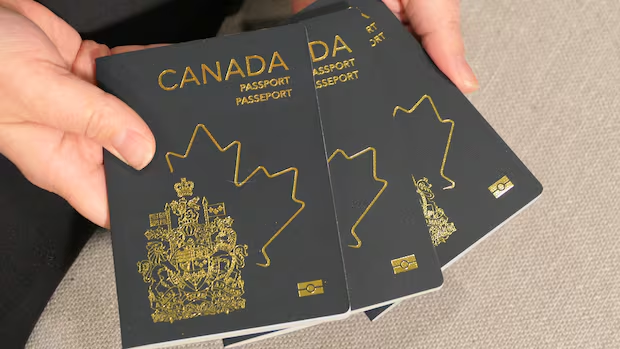
Canada has just taken a monumental step, extending automatic citizenship to a long-overlooked group: children born or adopted abroad to a Canadian parent who was also born outside the country. This isn’t just a technical update to **immigration law**; it’s a profound move to welcome home thousands of individuals historically known as ‘Lost Canadians’. The new **citizenship bill**, which officially came into effect on Monday, addresses decades of legal complexities and personal hardship.
For generations, “Lost Canadians” have grappled with the pain of being denied their rightful heritage. This term refers to people who, through no fault of their own, either lost or never acquired **Canada citizenship** due to what Ottawa previously acknowledged as “outdated provisions” in its **citizenship descent** laws. These provisions, at times stringent and discriminatory, created a baffling maze for many seeking to establish their ties to the Great White North.

The catalyst for these sweeping changes was a pivotal 2023 Ontario court decision. This ruling declared parts of the existing law, which severely limited **citizenship by descent**, unconstitutional. The court’s intervention followed a controversial 2009 law passed under the former Conservative Prime Minister Stephen Harper’s government. That legislation had stripped away the automatic right to citizenship for descendants of Canadians born abroad, inadvertently creating a new wave of ‘Lost Canadians’.
In a significant shift, the current Liberal government chose not to appeal the 2023 Ontario Superior Court of Justice ruling. On Monday, they affirmed their agreement that the previous law had “unacceptable outcomes for children of Canadians who were born outside the country.” This commitment paves the way for a more inclusive approach to **Canadian parents** passing on their nationality.
However, the new regulations aren’t without conditions. To qualify, the Canadian parent must demonstrate a “substantial connection” to the country, meaning they must have resided in Canada for at least three years prior to their child’s birth or adoption. This condition aims to balance inclusiveness with genuine ties to the nation.
The impact of this **citizenship bill** is expected to be substantial. While Immigration, Refugees and Citizenship Canada doesn’t have an exact figure, they anticipate applications could reach into the tens of thousands over time. Canada’s Parliamentary Budget Officer, an independent body, projects that roughly 115,000 individuals could be affected by these changes over the next five years, marking a significant demographic shift.
The journey to this new law wasn’t entirely smooth. Conservative MP Michelle Rempel Garner, the shadow minister for immigration, raised concerns in November, suggesting the bill might lead to “unfettered citizenship by descent and create untold citizens of convenience.” Alongside the Bloc Québécois, Conservatives sought amendments for more stringent requirements, including language proficiency and security checks for adults. However, these proposed amendments failed to pass in the House of Commons.

Amidst the policy discussions, real-life stories are emerging. One of the first beneficiaries of these changes is Alfie Jones, a British-born football player recently recruited to play for Canada in the 2026 FIFA World Cup. His grandmother, hailing from Alberta, provided the crucial ancestral link, allowing him to gain **Canada citizenship** under the new provisions, as reported by the Globe and Mail. Jones’s story exemplifies the personal significance of this historic **citizenship bill**, offering a pathway for many more ‘Lost Canadians’ to finally reclaim their place in the Canadian family.
This revised **immigration law** not only rights historical wrongs but also strengthens Canada’s commitment to its global diaspora, ensuring that a connection to the country’s roots can span generations, regardless of where one is born.