
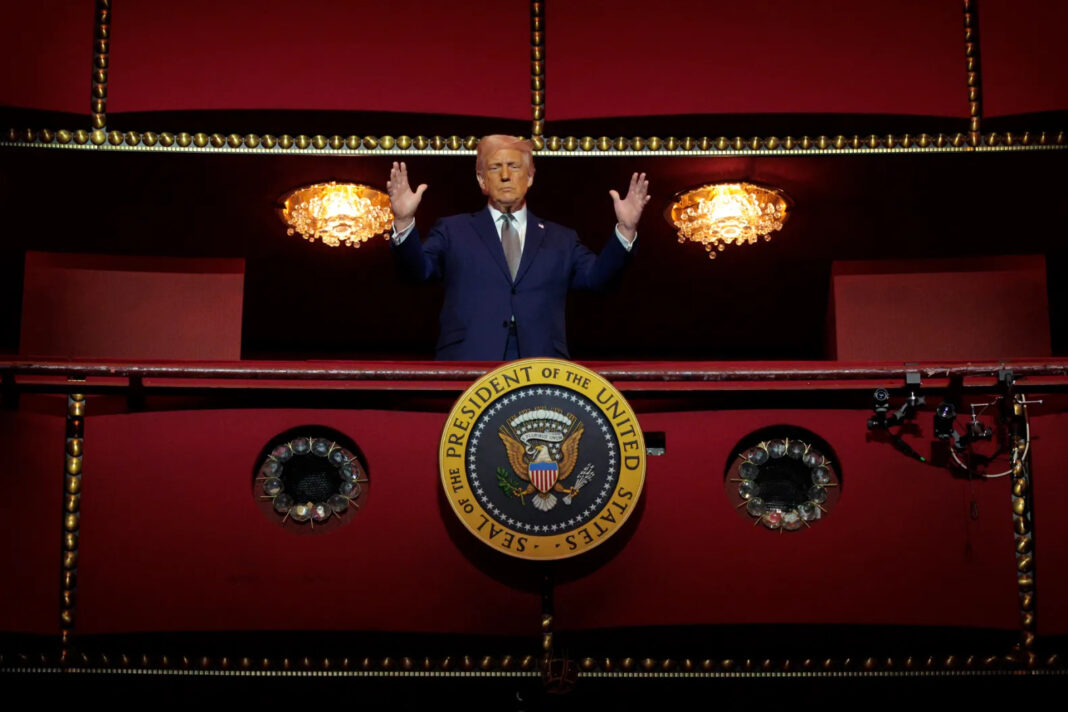
Washington D.C. is ablaze with controversy following the White House announcement that the iconic John F. Kennedy Center for the Performing Arts will be renamed the “Trump-Kennedy Center.” This audacious “White House decision,” revealed by Press Secretary Karoline Leavitt, cites a “unanimous board vote” to honor President Trump’s alleged efforts in “saving the building,” immediately igniting a firestorm in the world of “cultural politics.”
According to Leavitt, the “board vote” was a testament to “the unbelievable work President Trump has done over the last year in saving the building.” She even extended congratulations to the late President John F. Kennedy, envisioning a “truly great team long into the future.” President Trump, speaking from the Oval Office, expressed his surprise and honor, though he had previously joked about such a change at the Kennedy Center Honors event. He emphasized his role, stating, “We saved it. It was really in bad shape, physically,” and highlighted the $257 million in congressional funding he secured for renovations.
The swift transformation of the “Kennedy Center” board, however, lies at the heart of the “arts controversy.” Soon after taking office, Trump systematically replaced all existing board members with a cadre of loyal allies. This new board then controversially voted him chairman, with close adviser Richard Grenell becoming board president. Attorney General Pam Bondi, White House Chief of Staff Susie Wiles, Second Lady Usha Vance, and other political allies now populate the board, fundamentally altering its political landscape.
Despite claims of unanimity, the decision has been vehemently disputed. Ohio Democratic Representative Joyce Beatty, a current board member, revealed, “This was not unanimous. I was muted on the call and not allowed to speak or voice my opposition to this move.” Jack Schlossberg, Kennedy’s grandson and a vocal Trump critic, echoed this on X, stating, “microphones were muted” and the “vote NOT unanimous.” Other members of the Kennedy family have also voiced outrage. Joe Kennedy III, a grandnephew, stressed that the “Kennedy Center” is a federal memorial established by law and “can no sooner be renamed than can someone rename the Lincoln Memorial.” Maria Shriver, Kennedy’s niece, found the idea “beyond wild” and “downright weird,” calling it “obsessive in a weird way.”
Senior Democrats on Capitol Hill, including Senate Minority Leader Chuck Schumer and House Democratic Leader Hakeem Jeffries, reinforced that federal law prohibits changing the center’s name without Congressional action. They criticized the meeting for its “troubling lack of transparency and respect for the rule of law.” While congressional approval might be legally required for an official name change, the center could still alter its name on its website, tickets, and potentially the building exterior, much like the Department of Defense’s controversial name change to the Department of War without congressional consent.
Beyond the renaming, Trump’s involvement has sparked a broader “arts controversy.” The political interference has led to cancellations by prominent artists like Lin Manuel Miranda and other visiting performers. Dozens of staff members responsible for artistic decisions have resigned or been fired. Locally, ticket sales and subscriptions have reportedly plummeted. Trump himself boasted of being “98% involved” in selecting honorees, proudly rejecting “wokesters” from consideration. This latest development at the “Trump Kennedy” Center underscores a deep and growing divide in American “cultural politics,” pitting a presidential administration against established cultural institutions and their legacies.