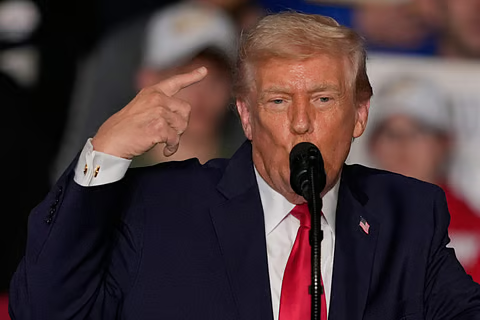

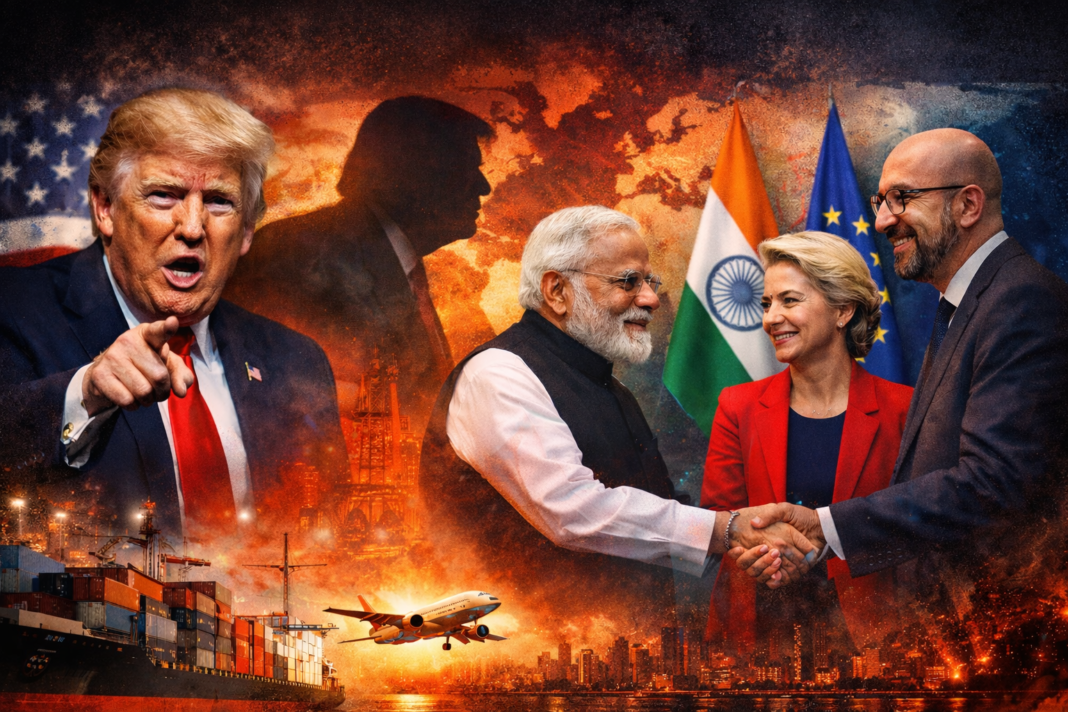
Negotiations for a long-anticipated trade deal between India and the European Union are gathering pace — but looming over the talks is the potential return of Donald Trump and the trade uncertainty his policies could bring.
Diplomats and trade officials on both sides acknowledge that global politics, particularly Washington’s increasingly protectionist stance, is reshaping calculations in Brussels and New Delhi.
Why the India–EU Trade Deal Matters
The proposed agreement, often described as one of the world’s most ambitious free-trade negotiations, aims to:
-
Boost bilateral trade and investment
-
Reduce tariffs and regulatory barriers
-
Secure supply chains
-
Deepen strategic cooperation
Together, India and the EU represent nearly a quarter of the global population and a massive share of world economic output. A successful deal could redefine trade flows between Asia and Europe for decades.
Trump Factor: A Catalyst for Urgency
The possible return of Trump to the White House has injected fresh urgency into the negotiations. Trump’s past policies — including tariffs, trade confrontations, and skepticism toward multilateral agreements — rattled global markets and strained relationships with both allies and partners.
For India and the EU, the concern is not just about the United States, but about a more fragmented global trade system where:
-
Protectionism replaces predictability
-
Trade disputes become geopolitical tools
-
Multilateral rules weaken
A strong India–EU deal is increasingly seen as a hedge against that uncertainty.
Europe’s Strategic Calculation
European leaders view closer economic ties with India as a way to:
-
Diversify away from over-reliance on China
-
Reduce exposure to U.S. trade volatility
-
Strengthen partnerships with democratic economies
If U.S. trade policy becomes more unilateral again, Brussels wants alternative growth engines — and India’s expanding market fits that role.
India’s Perspective
For India, the deal offers:
-
Greater access to European markets
-
Investment in manufacturing and technology
-
Integration into high-value supply chains
But New Delhi is also cautious. Officials want to protect domestic industries, agriculture, and data sovereignty — and remain wary of commitments that could limit policy flexibility in an unpredictable global environment shaped by U.S. politics.
Sticking Points in the Negotiations
Despite renewed momentum, several issues remain contentious:
-
Tariffs on automobiles and industrial goods
-
Environmental and labor standards
-
Data protection and digital trade
-
Intellectual property rights
Trump’s trade legacy has reinforced a belief on both sides that future trade deals must be resilient, not just economically beneficial.
Geopolitics Over Pure Economics
Unlike earlier trade talks, the India–EU negotiations are now deeply geopolitical. Officials privately admit the deal is no longer just about tariffs and quotas — it’s about strategic autonomy.
If U.S. trade policy swings sharply again, countries with strong alternative partnerships will be better positioned to weather shocks.
A Deal Shaped by Global Uncertainty
Trump’s shadow does not mean opposition to the deal — quite the opposite. His unpredictable approach to trade has strengthened the case for:
-
Faster negotiations
-
Broader strategic alignment
-
Long-term economic security
In this sense, Washington’s uncertainty is pushing Brussels and New Delhi closer together.
What Happens Next
Negotiators are expected to intensify talks in the coming months, with both sides signaling political will to move faster than in previous rounds. Whether a final agreement can be reached soon remains uncertain, but momentum is stronger than it has been in years.
Final Take
The India–EU trade deal is no longer just a commercial negotiation — it is a response to a shifting global order. As Trump’s influence once again shapes international expectations, India and Europe are recalibrating, seeking stability through partnership.
In a world of rising protectionism and geopolitical rivalry, the deal is as much about future-proofing as it is about free trade.