

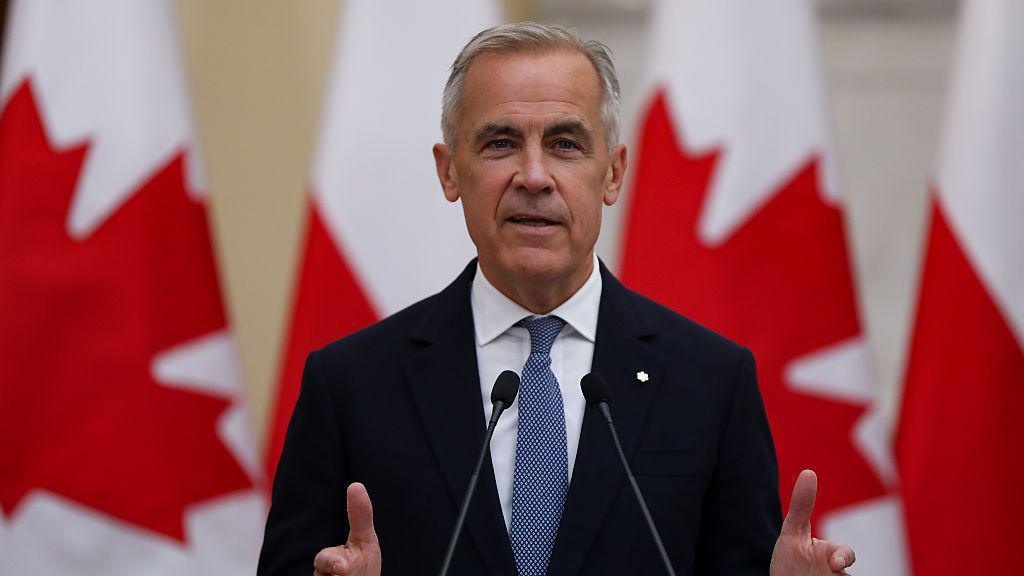
It might seem like a minor detail – a single letter, perhaps an ‘s’ where a ‘z’ should be – but a brewing linguistic battle is challenging Canada’s sense of self, all thanks to Prime Minister Mark Carney. Canadian language experts are publicly calling out the nation’s leader for allegedly “utilizing” British spelling in official government documents, urging him to return to the distinctly Canadian English long enshrined in national communications.
For decades, Canadian English has been the accepted standard for all government communications. This unique dialect, a proud blend of influences from both American and British English owing to Canada’s geography and history, also boasts its own charming ‘Canadianisms’ – think ‘toque’ for a winter hat or ‘washroom’ instead of a ‘bathroom’ or ‘loo’. While it leans into British tradition with ‘ou’ in words like ‘colour,’ it firmly rejects others, such as ‘tyre’ for ‘tire.’ A pivotal distinction often lies in the ‘z’ versus ‘s’ usage, like ‘analyse’ in British English versus ‘analyze’ in Canadian and American forms.
However, eagle-eyed linguists and editors have recently spotted a shift. British spellings like ‘globalisation’ and ‘catalyse’ have appeared in significant documents from the Carney government, including the recent budget. This perceived departure from the norm prompted Editors Canada, along with four prominent linguistics professors and the editor-in-chief of the Canadian English Dictionary, to pen an open letter to Prime Minister Carney. Dated December 11th, the letter emphasized that adherence to Canadian English is “a matter of our national history, identity and pride.” They warned that a governmental shift away from established Canadian spelling could lead to “confusion about which spelling is Canadian,” potentially eroding a cornerstone of national identity.

Many are speculating on the root cause of this linguistic deviation. Professor JK Chambers, a renowned Canadian linguist from the University of Toronto and a signatory of the letter, pointed out that Mark Carney spent significant years of his adult life in the UK, including seven years as the governor of the Bank of England. “He obviously picked up some pretensions while he was there,” Prof. Chambers quipped, though he jokingly added, “So far, bless him, he has not resorted to \’gaol\’ for \’jail.\'” Kaitlin Littlechild, president of Editors Canada, highlighted at least two notable instances: the Carney government’s budget released in November and an October news release following a working visit to Washington, D.C.
The debate transcends mere grammar; it delves deep into the heart of Canadian identity. Professor Stefan Dollinger of the University of British Columbia, another signatory, articulated the sentiment: “language expresses identity.” He expressed concern that the Prime Minister’s Office might be “walk[ing] the clock back by half-a-century or more,” effectively undoing the linguistic evolution Canada has undergone since its colonial past. The linguists even tied the issue to a term Carney himself uses – taking an ‘elbows up’ stance, an ice hockey reference for defiance, arguing that using Canadian English is “the simplest way to take an \’elbows up\’ stance” in preserving national distinctiveness. Whether this is an accidental “misunderstanding” or a “targeted directive” from the top remains unclear, as the BBC awaits comment from Carney’s office.
In a world where national identities are constantly shaped and reshaped, the subtle nuances of language become powerful symbols. This spelling debate surrounding Mark Carney and the use of British spelling in government documents is more than just about correct grammar; it’s a passionate plea for the preservation of Canadian English and a reflection of what it means to be Canadian. As experts emphasize, our words not only communicate but also define us, making this linguistic call-out a vital discussion about the very fabric of national language identity.